|
|
|---|
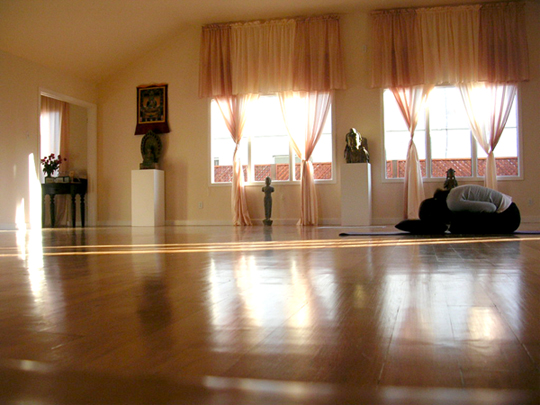 Natural lighted yoga studio
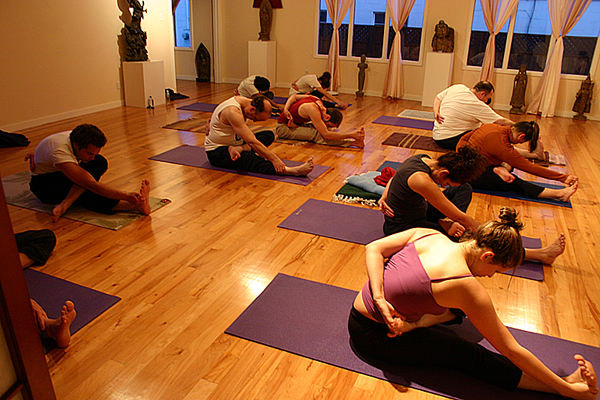 Yoga and movement classes
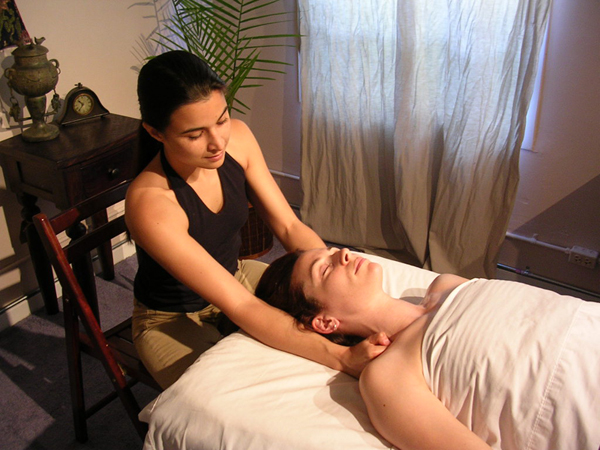
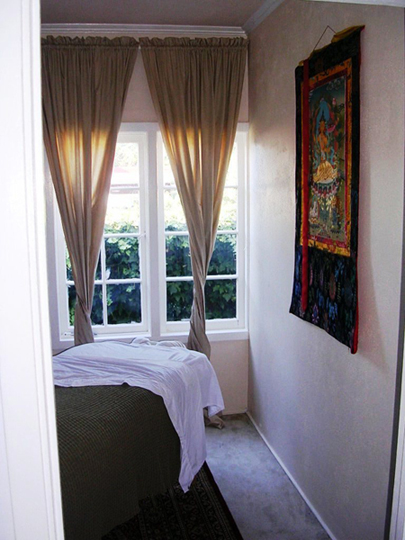 Three massage rooms
|
|
Yoga
The Indian sage Pantanjali (200 BC), systematized the science of self inquiry in Sanskrit. In his treatise, the Yoga Sutras, he describes the eight limbs, which is known by its Sanskrit name, Ashtanga Yoga (eight-ashta, limb-anga). Patanjali's eight limbs are:
They address the
cultivation of awareness in everything from proper ethical conduct to
meditation. The third branch of this system, asana - also known as Hatha
Yoga, focuses on the strengthening and purification of the body. An asana
practice integrates the breath and the body into a cohesive whole.
Ashtanga Vinyasa 1-3 A fun and vigorous class that keeps a continuous flow within a fixed series of postures linked with the breath (Vinyasa) originally taught by Sri K. Pattabhi Jois. You will build endurance, strength, flexibility, and grace along with bringing peace to your mind. Beginners welcome who have some yoga experience and/or have a dance or athletic background. Gentle yet firm hands on adjustments are given to ensure correct alignment. Posture modifications will be taught to the beginning students and the more challenging/full exalted postures will be given to the intermediate/advanced students. Gentle Yoga (Acu-Yoga) A system of self-healing that integrates the knowledge of two ancient techniques, acupressure and yoga, increasing the effectiveness of each end, giving you self-treatment techniques for stress, tension and pain. This class is appropriate for students of all levels and no prior yoga experience is necessary. Hatha 1-3 A fun all abilities class combining the focus on alignment with the fluidity and grace of a vinyasa style class. Each class includes static strength building poses as well as flowing sequences that connect movement and breath. Posture modifications will be taught to the beginning students and the more challenging/full exalted postures will be given to the intermediate/advanced students. Hatha Flow 1-3 Alignment-based Yoga 1-2 This yoga is a system of hatha yoga which focuses on correct alignment of the bones and spine, training the muscles to support this structural alignment. Props are also used to adjust the poses to suit the students strengths and limitations enabling the student to open their body/mind in a safe and methodical manner. You will explore a full range of postures; from opening poses, standing poses, forward bends, backbends, twists, inversions, restoratives and meditation. All levels welcome. Sunrise Vinyasa Imagine how your day would flow if you gave to yourself first! You would have more energy to give to others and the world in all the ways you already do! Come join us in celebrating the sun rising in a fun and challenging class that keeps a nice groove, links postures with breath (Vinyasa) to build strength, flexibility, endurance, grace as well as bringing peace to your mind. Just as in the Ashtanga classes, the series begins with sun salutations to warm the body and moves to link standing, balancing, forward bends, twists, inversions with vinyasas and ujayi breath. Gentle yet firm hands on adjustments are given to ensure correct alignment. Modifications will be taught to the beginning students and the more challenging/full exalted postures will be given to the intermediate/advanced students. Vinyasa Yoga The Yoga of Self-Acceptance For anyone with at least 6 months asana practice ( or less, if you promise to not try to look like all those beauties on the yoga calendars!), this class will help you find comfort in the traditional yoga asanas. This is not a new way to do asana. It is a way for you to honor your body, your strengths, and your limitations. The goal is to find “right” effort, not maximum effort. It is achieved through application of the 5 Not-So-Noble-Truths: Slow Down, Pay Attention, Breathe, Relax, and Lighten Up. Since we focus on making the asana fit your body and practice, this class is great for newer and long time students alike. It can be strenuous or easy depending on your inclination and intuition. Our goal is the make the asana your own. The asanas are altered to fit your body, rather than vice versa. We follow the admonition of Gary Kraftsow (There is a perfect way to do each posture; it just may be different for each person!) Erich Schiffmann (Yoga shouldn’t hurt) & Richard Rosen (We have to put the ha back in hatha) The diligence and perseverance of the yoga practice is an honored tradition; we simply feel that a little lightening up wouldn’t hurt either.
For Class Schedule Click
HERE.
Sophia first fell in love with physical expression and movement through ballet at the age of eight. She discovered yoga, long after hanging up her toe shoes, and it has supported her growth and musical creativity ever since. Sophia is deeply grateful to have studied and received 200 hour certifications with Antonio Sanchez in hatha yoga (2002), Larry Shultz of Its Yoga in astanga vinyasa (2005), and most recently 100 Immersion hours in Anusara Yoga with Abby Tucker and Sianna Sherman in September of 2011. Sophia holds a BA in psychology from C.I.I.S.. Sophia believes that yoga is a lifelong practice and that it is never too late to awaken to joy and to follow your heart!
Lela Davia Lela Davia, M.S. is a graduate of the Acupressure Institute in Berkeley, CA and is a certified Acu-Yoga instructor. She has taught both Hatha Yoga and the Acu-Yoga Teachers Training at the Acupressure Institute and has taught classes at Kensington Physical Therapy center, and VARA Healing Arts in Albany, CA. She is on the teaching staff at the annual California Alliance for Women residential retreat, and at Cazadero Music and Arts Family Camp. Lela recently became a certified Arthritis Exercise Class instructor through the Arthritis Foundation. She is dedicated to encouraging a fit and healthy lifestyle for all ages, through movement.
Rosy Schlussel Embodied practice has been a theme throughout Rosy's life. A dancer in her early years, she went on to Circus School in Bristol and London as an alternative to a traditional college education. Rosy committed to her Yoga practice in earnest in 2000 as a way to survive the London winter; Studying Astanga Mysore Style at The Yoga Place in Bethnal Green under Alexander Medin and Sara Litton. She became an apprentice to Alexander in 2001 and was encouraged to teach soon after this. She has remained a student of various styles and has taught yoga to pre and postnatal mothers. She gravitates toward the alignment principles and heart of Anusara and the depth, clarity and simplicity found in the Tantrik Hatha tradition. Rosy considers Yoga an opportunity to not only enjoy our bodies, but know ourselves with greater depth and grow into being love. Rosy is also a Life Coach, practicing Buddhist and mother of two. Tony Wolff Tony Wolff is author is author of The Yoga of Self Acceptance, to be Viji Sundaram A yoga and Acu-Yoga instructor, has taught both in the US and in India for 18 years. She is a certified acupressurist (Acupressure Institute, Berkeley, Ca.) yoga teacher (Sivananda International Yoga Vedanta Center) and acu-yoga teacher (Acupressure Institute, Berkeley). She has studied pranayama from one of the best teachers in India. She has conducted workshops in both countries, as well as in Kenya, and, to date, has taught more than 3,000 students.
Ahimsa, the yogic practice of non-violence must be
adhered to when engaging in the practice of yoga. Respect your body's
limitations and inner wisdom, if something feels wrong or dangerous, please
do not do it. Yoga students are encouraged to bring their own sticky mat. If
you do not have one, you can purchase one just about anywhere. Owning your
own sticky mat is hygienic and it encourages you to practice yoga at home.
If you have your own strap and blanket, bring it along. Most importantly,
bring yourself. Yoga is traditionally practiced on an empty stomach, but
don’t come to class starving. Just give your body ample time to digest a big
meal, at least two to three hours. If you snack lightly before class, allow
an hour or so for digestion. It is better to practice yoga on an empty
stomach, however your body needs energy, so keep yourself well nourished and
listen to your body! Come prepared to practice in bare feet. You will want
to dress comfortably by wearing clothing that you can move easily in without
restriction. Tight clothing is uncomfortable, especially when you need to
breathe. Dress according to the seasons. The Temperature in the studio is
usually very warm. However, if you are prone to being cold, wear layers that
you can always peel away. Yoga asanas make you warm. Please refrain from
wearing perfumes and heavy scents when you come to class. As your body heats
up, so will the scents and they will disperse into the air. Some students
are very sensitive to smell and may have allergic reactions. There are many benefits that individual can gain from the practice of yoga. At the physical level, yoga can act as a cleansing process that has proven to be extremely effective for various disorders. Here are some of the benefits of yoga practice: increasing flexibility – there are positions in yoga that act upon the various joints of the body including those joints that we never really use. Increasing lubrication of the joints, ligaments and tendons – by practicing various yoga positions individual can start experiencing a remarkable flexibility in parts of the joints, ligaments and tendons. Research has shown that “non strenuous” yoga positions can act upon certain parts of the body in an interrelated manner. If combined together they work in harmony to create flexibility. Massaging to all organs of the body – Research has shown the yoga exercise is probably the only form of activity that massages all of the internal glands and organs of the body to promoted good health and well-being. Complete detoxification – yoga exercise helps to gently stretch the muscles and joints allowing the optimum blood supply to various parts of the body. This helps to flush out the toxins in the body. Hence, leading to benefits such as delayed in ageing, providing energy and a remarkable zest for life. Excellent toning of the muscles – yoga can heal muscles that have become flaccid and weak. By practicing yoga it can encourage repeated stimulation that helps to shed excess flab and flaccidity. Provide balancing of the nervous system – yoga is a great form of mediation that can balance the nervous system. Reduction of stress – because yoga is a slow and gentle form of exercise combined with a control breathing exercise it can promote relaxation to the body.
Dualism & Non-Dualism Comparison Dualism and Non-Dualism We may believe in one or the other of the philosophies of Dualism or Non-Dualism. We may see these philosophies as either contradictory or complementary. However, when we want food or sex, or feel threatened, we automatically respond from Dualism, not Non-Dualism. If we watch a person die, or look at a corpse, are we not all struck by the mystery of apparent matter and consciousness? The higher truth quickly goes out the window in such moments and we find we are faced squarely with the Dualistic, conditioned response of the stuff of our mind. There is something between us and Truth, the Absolute Reality, and that is called the mind. Training the mind is the starting point for Patanjali, in the Yoga Sutras. For example, one of the first things he talks about is observing which of our thoughts are useful or not useful, positive or negative. Then he directs us to learn to make choices in life on the basis of what is positive and helpful in our growth, choosing to do that which we know leads towards a stable, inner state of tranquility. Such self-observation, self-examination, and self-training are necessary in preparation for the deeper practices. The Dualism of the Yoga Sutra gives us detailed instructions on how to clear away the clutter so we can find the door. Non-Dualistic Vedanta philosophy gives us a sound contemplative base for deeper understanding of the nature of the door and that which is beyond. Tantra shows us how to open the door, as well as how and where to knock. To view these as contradictory leads to confusion. To view them as complementary leads to freedom. We can apply the Dualistic and Non-Dualistic philosophies as different aspects of the same one journey within, which eventually leads to the direct experience of the center of consciousness, wherein all these questions are resolved and dissolved.
|